About
Biblelexical was built for the church and for anyone curious about the Bible as a quiet, free, offline place to read, study, and write.
From the first screen
Biblelexical opens with a simple promise and never asks for an account. Write sermons with Scripture built in, study every verse, build a daily habit, and do all of it free and fully offline.
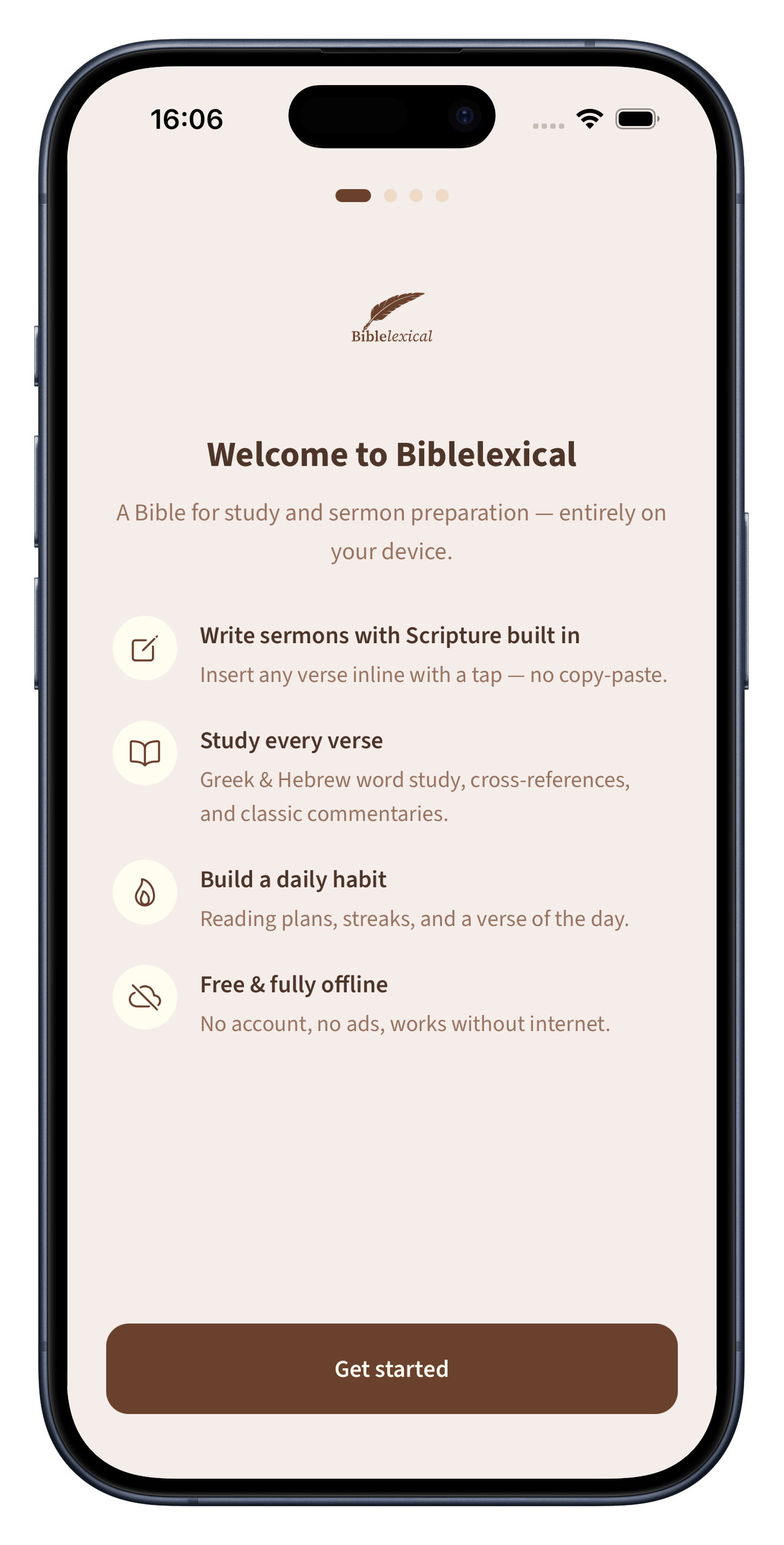
Most Bible apps want you online, signed in, and surrounded by buttons. Biblelexical began with a simpler idea in mind... A peaceful place to read Scripture and think, with serious study tools close at hand and a private desk to write on and none of the noise. It is made by one developer for personal use, for friends, and for a local congregation, and shared freely with anyone who would find it useful.
Your reading and your writing are yours. Biblelexical has no account, no server, no ads, and no tracking. Everything you do lives on your own device. The app works fully offline, and if you ever switch phones you can carry your notes across yourself with a simple backup. This is a deliberate choice, not a missing feature.
Several of the resources below are generously licensed for non-commercial use, and keeping the app free is part of honoring that. There is no subscription and nothing locked behind a payment.
Biblelexical stands on the work of many people and projects. We're grateful to each of them. Full license texts are also shown inside the app under Settings → About & licenses.
The bundled English text is public domain. Additional translations are sourced from eBible.org via the helloao Bible API. The Serbian Novi srpski prevod is © Biblica, Inc., used under CC BY-SA 4.0.
Hebrew and Greek word data comes from STEPBible (TAHOT/TAGNT, CC BY 4.0, Tyndale House Cambridge) with Strong's numbers from OpenScriptures. Septuagint words draw on CenterBLC/LXX, CATSS (UPenn), and Rahlfs 1935 (non-commercial use).
Cross-reference data is from OpenBible.info, used under CC BY 4.0.
Public-domain commentaries (John Wesley, Matthew Henry, John Gill, John Calvin, George Haydock, and the Catena Aurea) are compiled with thanks to StudyLight.org.
Set in Source Serif 4 and Source Sans 3 (© Adobe), with Cardo for Greek and Hebrew and OpenDyslexic as an accessibility option all under the SIL Open Font License 1.1.
Reading plans
The reading plans (Bible in a year, New Testament in ninety days, Gospels in a month) are hand-made generic schemes, free to follow at your own pace.
A quiet place for the Word, your notes, and your study. Ad-free, with no catch attached.